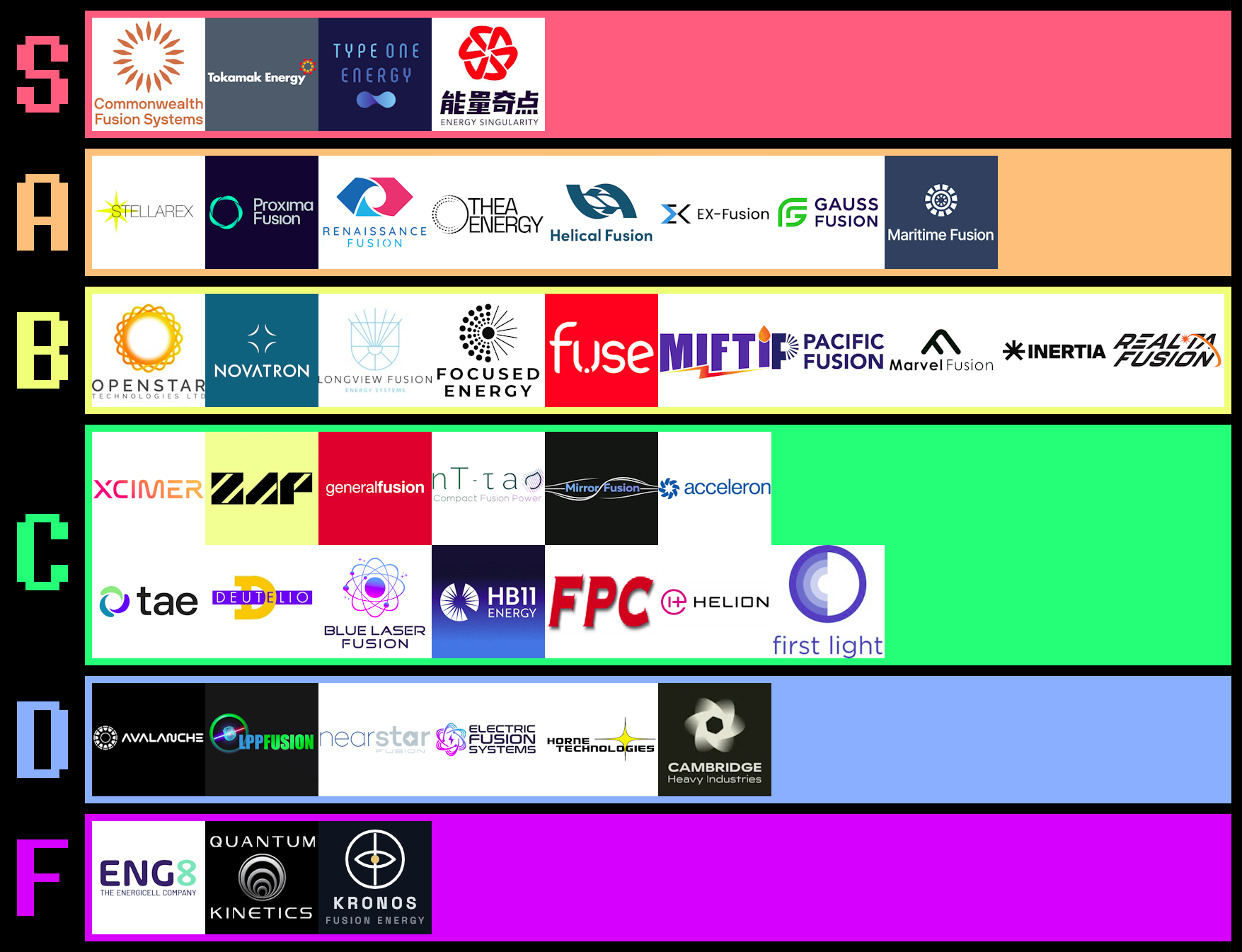

It’s been about two years since I published my 2024 Fusion company tier list, and a lot has changed. New nuclear fusion companies have cropped up, existing companies have changed their approaches, and new trends are emerging in the industry. So I think I should go over the recent developments and update my ranking with some companies that didn’t exist or that I neglected to include last time. This is not intended to be a comprehensive list as there are way too many companies for that now.
But first, I should disclose that as of this year, part of my salary is funded by Commonwealth Fusion Systems. Luckily, I’m a perfectly rational being so my judgements are still fair.
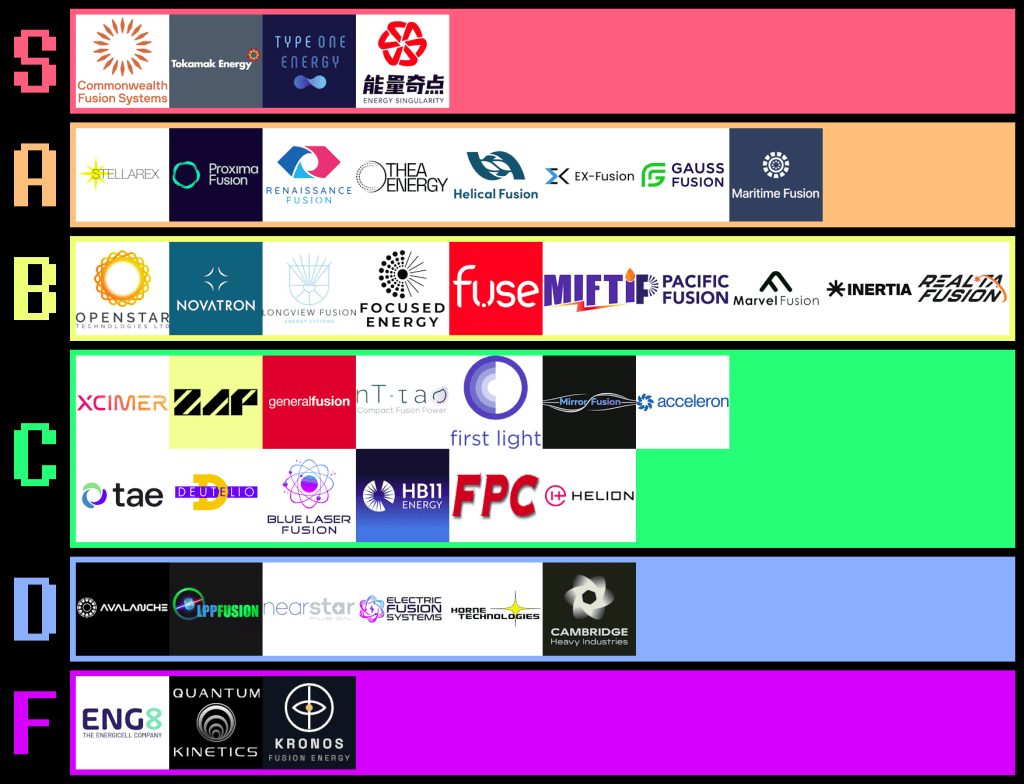
Progress by existing companies
Commonwealth Fusion Systems is progressing in the construction of their first reactor, SPARC. They claim that it is now 80% done and that it will turn on in 2027. It’s worth noting that it was originally supposed to turn on in 2025. As is often the case with these things, that timeline was overly optimistic. But they are making progress – the full vacuum vessel and ten out of eighteen of their toroidal magnet coils are now on display in their facility in Devens. So even if I suspect the 80% number is still optimistic, SPARC will probably turn on sometime soon.
Contrary to the my predictions, though, SPARC will not be the first tokamak to use high-temperature superconducting ReBCO magnets. That was scooped by Energy Singularity, which built HH70, the world’s first fully ReBCO tokamak, in June 2024. It’s too small to achieve an energy gain factor above one (SPARC will still probably be the first magnetically-confined reactor to do that) but it’s still a big achievement. If I had known when I made my original tier list that Energy Singularity had this in the works, I would have promoted them to S-tier. Better late than never, I suppose.
Type One Energy is farther behind but also making progress. Last year built and started testing Magnet Zero, the first model coil for their upcoming stellarator, Infinity One. This is analogous to Commonwealth’s model coil test in 2021, and the two companies worked together to adapt that technology for Type One’s needs.
Lots of other companies have started building or operating their first devices, but I won’t do detailed progress updates for all of them because none of them have broken any interesting records yet to my knowledge.
Some companies that had been cagey about their technology have started to release more details, which I think counts as progress. For instance, Marvel Fusion has announced that they are pursuing “hollow shell fast ignition”. I’m not entirely sure what that means, but assuming it’s the same as regular fast ignition just with a modified target shape, I think that’s reasonable enough to earn them a spot in B-tier with Focused Energy, the other fast ignition company.
nT-Tao has announced that they are pursuing small, high-density, pulsed stellarators. This is reassuring since previously all they would say was that they had a “proprietary topology”, which sounded super fake. On the other hand, though, this approach doesn’t make any sense to me. Stellarators are the most complicated and hardest to build of the magnetic confinement geometries – the only reason to build them is because they have great stability. Running it in pulses of a few milliseconds means you can’t take advantage of that. If you only need the plasma to stay on for a short amount of time, surely you do just as well for cheaper with a field reverse configuration, right? Anyway, I’m promoting them to upper C-tier.
Gauss Fusion, based in Munich, has recently announced that they’re doing high-field stellarators. Previously I had so little information about them that I didn’t even bother ranking them. But now that I know they’re using the same general approach as Stellarex, Proxima, Renaissance, Type One, and Thea, I’m putting it in A-tier with them.
Pivots by existing companies
While Commonwealth and others are slowly moving toward their original goals, other companies are changing direction. The reasons are usually not publically explained in detail, but I usually assume it’s because their initial prototypes didn’t work as well as they were expecting.
For example, First Light Fusion has changed their approach from projectile fusion to magnetized liner inertial fusion (magLIF) with fast ignition. This is a welcome change, since there was no way projectile fusion was ever going to work. Fast-ignition magLIF is still a little out there – while magLIF is well studied, fast ignition has never actually been proven feasible – but it’s at least grounded in existing science. That said, I’m hesitant to move them too far up the tier list because I don’t have a lot of faith in a team that thought projectile fusion was a good idea in the first place. They can move from lower C-tier to upper C-tier.
Speaking of Z-pinches, Zap Energy has branched out from pure fusion reactors to fission–fusion hybrid reactors, and has changed their logo and slogan accordingly. They’re continuing to develop their gas-gun Z-pinch, but are also now developing a sodium-cooled modular fission reactor in parallel. Eventually they hope to integrate the two technologies: use a fusion reactor to generate fast neutrons which drive a reaction in subcritical fission fuel. Fission–fusion hybrids have long been a controversial subject in the nuclear energy space because the synergies between the two are not all positive. The safety optics are better for a hybrid than a fission reactor, since a loss of power will stop the reaction, but not as good as a fusion reactor since you still have to deal with uranium and its byproducts. The plasma confinement requirements aren’t as strict for a hybrid as for a fusion reactor, since the plasma doesn’t have to be energy-positive, but they’re stricter than a fission reactor since you do still need to run a fusion reaction. Hybrid reactors do have one unique selling point, though: they can extract energy from and break down spent fission fuel. Overall, I think the pivot is interesting, but I don’t think it changes their position on the tier list.
In a more bizarre update, TAE (formerly Tri-Alpha Energy) has merged with Trump Media (the owner of Truth Social). I don’t know if this has any effect on their technical progress, but it’s strange enough that I thought it was worth mentioning.
And there have been a few geographic pivots. Focused Energy has moved their US office from Austin to Redwood City, adding to the growing fusion hub in the San Francisco Bay Area, while Pacific Fusion has moved out of the Bay Area into Albuquerque, making their name weirdly inaccurate.
New companies
And of course, plenty of new companies have formed or exited stealth mode in the last two years. One such company is Inertia, based in Livermore, California. Like Longview, their approach is inertial confinement via laser indirect-drive. Like Pacific Fusion, Inertia is founded and heavily staffed with scientists from the National Ignition Facility. One of the co-founders is Annie Kritcher, who designed the first laboratory experiment to achieve a self-sustaining fusion reaction in 2021, and Inertia’s strategy is to build on those experiments with as little scientific risk as possible. I’m putting it in B-tier with the other laser fusion companies.
Mirror Fusion LLC is a new company based in Bedford, Massachusetts, pursuing (you’ll never guess) mirrors, similar to Novatron. But they have some interesting variations on the idea. For one thing, they plan to drive rotation in the plasma by putting electric motor coils on the ends. They also plan to fire charged particle beams through the ends and use the two-stream instability to make them deposit their energy in the plasma. They also plan to tune the electron and ion densities to establish an electrostatic potential in the plasma to help confine the ions. There are a lot of untested ideas here, and as I understand it, the modelling of the motor coil concept is still immature, but it is at least building off of a pretty well-understood concept. Upper C-tier.
Cambridge Heavy Industries is a company based in Cambridge, Massachusetts, pursuing a sort of planar laser-driven fast ignition, where hollow laser pulses with decreasing diameter come down from above and compress a target against a planar surface, and then a high-power laser or particle beam ignites it. In my opinion, this will inherit the poor confinement of projectile fusion – there’s no way you can reach the needed temperatures and pressures when the laser is only coming from one direction – along with the technical challenges of fast ignition. D-tier.
One really interesting one is Acceleron Fusion, also based in Cambridge, Massachusetts. They’re pursuing muon-catalyzed fusion, which is technically a form of cold fusion, but based on real physics. A muon is a particle with the same charge as an electron but hundreds of times more mass. When muons are injected into regular matter, they can displace the electrons that bind atoms together to form muonic molecules. Muonic hydrogen molecules are so small that deuterium and tritium nuclei inside them can spontaneously fuse together at room temperature. Because muon-catalyzed fusion doesn’t require hot plasmas, it sidesteps many of the technical challenges of conventional hot fusion. Unfortunately, muons only stay in the fuel for a short amount of time, and it’s quite energy-intensive to create them, so it’s still not guaranteed that a muon-catalyzed fusion reaction will produce enough energy to pay for itself. In the last major muon fusion experiments in the 50s, it never did. I consider Acceleron upper C-tier since there’s no theoretical reason to expect that making this energy-positive is possible, but if they do succeed, it will almost certainly be cheaper than any other fusion concept out there.
A few companies are distinguishing themselves not by how their reactor works, but by where they plan to sell energy. Traditionally, fusion has been developed primarily as a way to generate electricity. But electricity only makes up a minority of energy consumption, and the electricity market is becoming increasingly competitive as wind and solar continue to get cheaper and utility-scale batteries make them more versatile. This has driven some to target non-electrified sectors. For example, Realta Fusion, based in Madison, Wisconsin, is designing magnetic mirrors to power industrial processes (they’ve actually existed since 2022, but I neglected to include them in my last tier list), and Maritime fusion, based in San Francisco, is designing tokamaks to power ships. In my last tier list, my ranking metric was “how likely they are to be the first to put fusion energy on the grid”, so these companies would have both ranked low. But in retrospect that was unnecessarily exclusive, so I’m changing the metric to “how likely they are to be the first to sell fusion energy”. Realta goes in B-tier with the other mirrors, and Maritime goes in A-tier with the other tokamaks.
And unsurprisingly, there are plenty of new companies selling fraud. One amusing one I found is Kronos Fusion Energy. Their website is so AI-generated that even the photo of the founder and CEO is AI-generated.
Another interesting one is Quantum Kinetics Corporation, which claimed in late 2024 to have sustained a plasma with a temperature of 18 keV for twenty-four hours (this is an absurd claim – current fusion experiments only maintain their plasmas for a small fraction of a minute). They also claimed that the reaction somehow involved radioactive wastewater (it’s not clear if they’re implying that the trace amounts of tritium in the water that comes out of fission power plants is enough to undergo nuclear reactions, or if this is a cold fusion thing). Their claims were delivered confidently enough that the story was picked up by Interesting Engineering, though it was taken down a few days later.
Auxiliary companies
One new trend in the last two years has been the appearance of auxiliary fusion companies – startups that contribute to the development of fusion but don’t themselves plan to sell energy.
Some of these are pursuing other ways of commercializing fusion reactors. For example, many companies are planning to use the neutrons produced by fusion reactions to make medical radioisotopes, as an intermediate step before selling energy. SHINE Technologies, based in Janesville, Wisconsin, is leaning even further into this – they never plan to sell energy, and are already selling lutetium-177 (though it’s not clear to me whether they’re actually using a fusion reactor to make it).
There are other uses for fusion neutrons, as well. Marathon Fusion, based in San Francisco, is planning to make money by using them to, among other things, transmute mercury into gold. Their website calls this alchemy, but technically it should be called chrysopoeia since alchemy also encompasses other things that would probably be more controversial (like bringing people back to life, and creating homunculi). They’re not building any reactors themselves that I know of, but rather are developing blanket technology that they can integrate with other companies’ reactors such that even if the other companies don’t sell energy, they can at least sell gold and split the profit with Marathon.
Other auxiliary companies are explicitly focused on supporting other companies. One is Rutherford Energy Ventures, a finance company based in Cambridge, Massachusetts, working to standardize evaluations of fusion companies and help raise and distribute funding for them. Another is Daedal Systems, a diagnostics company based in Toronto aiming to develop measurement instruments for other companies’ reactors.
Kyoto Fusioneering actually also falls into this camp – in 2024, I wrongly pegged them as a generic toroidal magnetic confinement company, but their aim is actually to fill a broader role as an R&D firm to work on auxiliary systems and “key commercialization challenges” for fusion energy. Next Step Fusion, based in Luxembourg, is another such general-purpose fusion technology company.
I’m thrilled that these companies now exist, but I don’t know how to rank them among the others given how different their goals are, so I’m not adding them to the tier list.
Conclusion
April of 2024 was not really that long ago. Most of the major players today were also around then, and despite some deadlines passing in the intervening time, there haven’t been very many newsworthy achievements. But I felt compelled to make this update because things feel different now. The number of companies has increased even further (there are almost fifty on the tier list, but there are so many that I didn’t include, even beyond the auxiliary companies), people are talking a lot more about revenue streams other than electricity, and there are a bunch of auxiliary fusion companies now.
I feel like fusion’s vibe in the public consciousness has also changed. Fusion companies are talking a lot more about AI now, both as a potential customer and as a tool to help with their research and development, and this has been reflected in the public discourse as well. Of course AI and fusion have always had a connection – it’s no coincidence that Sam Altman has been involved with Helion since before GPTs existed – but I think it’s become more salient in the last few years. That connection might become a liability depending on how AI investment and public opinion trends in the coming years, but so far it’s been great for attracting venture capital. Who knows if the fusion industry would have gotten as big as it has if Wall Street wasn’t in such a speculative mood?
It still remains to be seen if nuclear fusion can be made profitable, but I’m optimistic, especially with the wider variety of economic niches that are now being explored. It will especially help if governments start properly incentivizing clean energy over fossil fuel energy – and with the EU’s new carbon tariff I think we’re moving in that direction. But then again, who knows what the state of the world will even be in five years. Maybe muon-catalyzed fusion will work. Or maybe LLMs will take over and hack the Earth’s climate control system and then we’ll all have to get jobs in the medical radioisotope industry. Anyway, fingers crossed for SPARC 2027!

