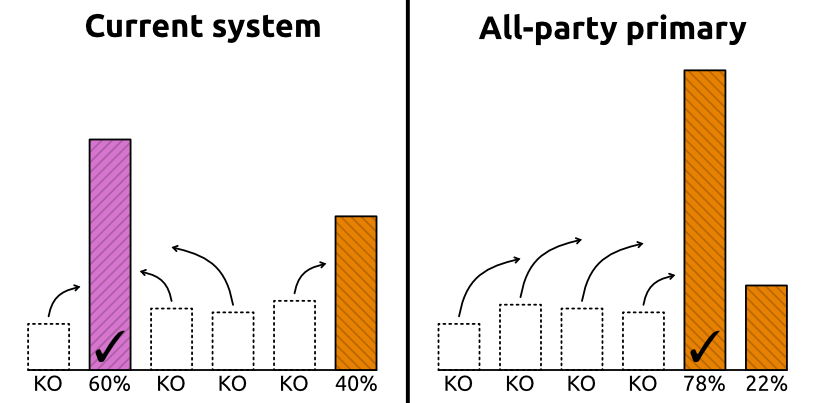

Question 3 on the Massachusetts ballot this year would institute all-party primaries (also known as “nonpartisan primaries”, “top-two primaries” or “jungle primaries”*) for all elections except municipal and presidential elections starting in 2028. This would replace our existing partisan primaries with a system where all candidates run on the same ballot in September (voters can still only vote for one), and then the two with the most votes compete in a one-on-one runoff election in November. Massachusetts would join California, Louisiana, Nebraska, and Washington as the fifth state in the USA to use this system.
Question 3’s backer, the Coalition for a Healthy Democracy (CHD), claims that all-party primaries will reduce partisan gridlock and make the government more responsive to the people. A careful review of the literature, however, finds that there is little evidence to support this claim. In addition, all-party primaries in California and Washington have caused perverse election results in some cases. Given that there are other more effective reforms that the CHD could have pursued instead, and that the vast majority of the CHD’s money comes from wealthy investors, I believe they are trying to influence our elections to elect more business-friendly Democrats. If you truly want to improve the quality of democracy in Massachusetts, I urge you to vote no on Question 3 and advocate for other reforms instead.
* The CHD insists that all-party primaries are different from the jungle primaries used in Louisiana, but in practice, the only difference is the time of year (Question 3 would have the first round in September and the second round in November, as opposed to Louisiana which has the first round in November and the second round in December) and whether the second round is mandatory (Louisiana skips it if there’s a clear winner in the first round).
The evidence for all-party primaries’ benefits is lacking
The CHD claims that research has found all-party primaries to increase turnout, lessen the role of money in politics, and make the legislature more representative of the voter base. I read through many of the studies they cite as well as many they don’t and found that while there is some science to support their claims, most of it is overstated or misrepresented.
Most studies do agree that replacing semi-open partisan primaries with all-party primaries increases total turnout in the primary.123 However, most find that the effect is small. The Bipartisan Policy Center estimated it to be about 3 percentage points.4
Researchers are more split on the effect all-party primaries have on election spending. Steven Sparks found that the effective cost of a vote is lower in same-party elections than in two-party elections,5 but it’s not clear whether this is good or bad for all-party primaries since they don’t create same-party competition – they just move it from September to November. A study commissioned by the CHD from an opinion polling firm found that all-party primaries in Washington decreased the importance of money in politics, but they didn’t publish error bars or sample sizes for most of their data, so I personally don’t buy it (weirdly enough, they did publish sample sizes for some of their data, even in a couple cases where they were small).6
Most research on all-party primaries focuses on whether they elect more moderate candidates. The idea is that in heavily skewed districts, two candidates from the same party will proceed to the general election, and then voters from the opposition party will help elect the more moderate of the two. This is often presented as a benefit because it reduces partisan polarization and gridlock. Researchers are divided on whether this actually bears out in the data, though. Some find that it does elect significantly more moderate politicians than partisan primaries,7,8 while others find that it has little or no effect.9,10,11 One study found significant moderation in California Democrats after it adopted all-party primaries, but noted that the effect was also present in term-limited candidates, meaning that it must have been caused by something other than the new primary rules.12 New America even argues that no election reform can reduce polarization because the electorate itself is too polarized.13
It’s also important to remember than moderate candidates are not always better (e.g. if one party wants to do nothing and the other party wants to kill a hundred people, then a candidate midway between them wants to kill fifty people). In the context of Massachusetts, moderation mostly means more business-friendly Democrats. Indeed, one (statistically challenged) study by the Unite America Institute (UAI) praises all-party primaries specifically because of the neoliberal politics of several Democrats elected under them.14 If you support neoliberalism then you may see this as a benefit, but it’s certainly not as policy-neutral as proponents suggest.
There are a number of studies performed or commissioned by the CHD and the UAI that I don’t list here, but I don’t lend them much credence because they tend not to show error bars or sample sizes and are rife with methodological errors. For instance, the CHD has one that shows that women and people of color are underrepresented in the Massachusetts legislature, and are better represented in California and Washington, and uses this to argue that all-party primaries improve the representation of women and people of color.15 But examining other states reveals this to be random noise. Arizona, Colorado, and New Mexico, which do not use all-party primaries, have better female representation than California and Washington. Meanwhile, Louisiana, which uses all-party primaries, is worse than Massachusetts.16
The UAI has another study that looks at California’s legislature’s performance metrics before and after it instituted all-party primaries in 2012, and argues that top-two primaries have reduced polarization and improved accountability.17 But causation is extremely hard to establish here because California also adopted independent redistricting at the same time. Going into the 2012 primaries, analysts already knew there would be a major upheaval in the makeup of its representatives just because of the new district borders and retirements.18 Some studies use statistical methods to try to correct for the effect of the new redistricting, but this one simply ignores it, so it’s impossible to attribute any improvements to all-party primaries.
So while all-party primaries do increase turnout, they do so only slightly. They may elect more moderate candidates than partisan primaries, but they may not, and in any case it’s not guaranteed that that would be a good thing for Massachusetts. Unfortunately, I did not find any good studies about their effect on campaign financing.
All-party primaries amplify vote-splitting and enhance partisan power
While evidence of all-party primaries’ benefits is sparse, there is clear evidence that the adoption of all-party primaries in California and Washington has caused harm. Specifically, there have been several elections where this method has elected people who clearly should not have been elected.
In the 2016 Washington State Treasurer primary election, for instance, 51.6% of people voted for one of three democrats while 48.4% voted for one of two Republicans. Even though the Democrats were in the majority, they split the vote such that only the two Republicans progressed to the general, where one of them won and served for four years. Similarly, in the 2022 California District 4 Senator election, 59.2% voted for one of six Republicans while 40.8% voted for one of two Democrats. The Republicans split the vote such that only Democrats progressed to the general.
This is not an intended or moderating effect of all-party primaries – it is a critical flaw that must not be overlooked. A system where the minority party can win just because the majority party fielded too many candidates is not a system that represents the will of the people.
The CHD downplays this concern, noting that these majority “lockouts” are rare. But the reason it doesn’t happen very often happen is because usually each party coalesces around one or two candidates. This is an even worse outcome, because it means that the reform has begotten the very thing it swore to avoid – power to the partisan establishment! Where the current system gives voters the power (or at least the illusion of power) to decide which candidates get to run in the general election, all-party primaries incentivize party leadership and funders to use their informal influence to make these decisions behind closed doors. I don’t mean to defend the current system; of course party leadership and donors have great influence in who gets to run in partisan primaries. But moving these decisions behind closed doors definitely won’t improve the situation.
All-party primaries need ranked choice. Ranked choice does not need all-party primaries.
There is one situation where I think all-party primaries can work well, and that’s when they’re combined with ranked choice voting (like in Alaska). In ranked choice systems, voters rank multiple candidates rather than voting for just one, and their rankings in aggregate determine the winner. This mitigates vote splitting, and thus enables anyone to safely run in the general election regardless of whether they have a party nomination, meaning that it would reduce party power.
To understand how it works, suppose there is a district where candidates are running for office from two parties: four from the Pinkie Party and two from the Orange Party. Suppose 60% of voters prefer Pinkies while 40% prefer Oranges, and that the candidates can be arranged on a single axis so that similar candidates are closer together. The diagram below shows what would happen under the current system, Question 3’s proposed all-party primaries, and instant runoff voting (the most popular type of ranked choice voting*). For simplicity, I assume that everyone votes in both the primary and general election for the candidate closest to them – of course this is not the case in real life, but it’s a good enough approximation to demonstrate the mechanisms at play.
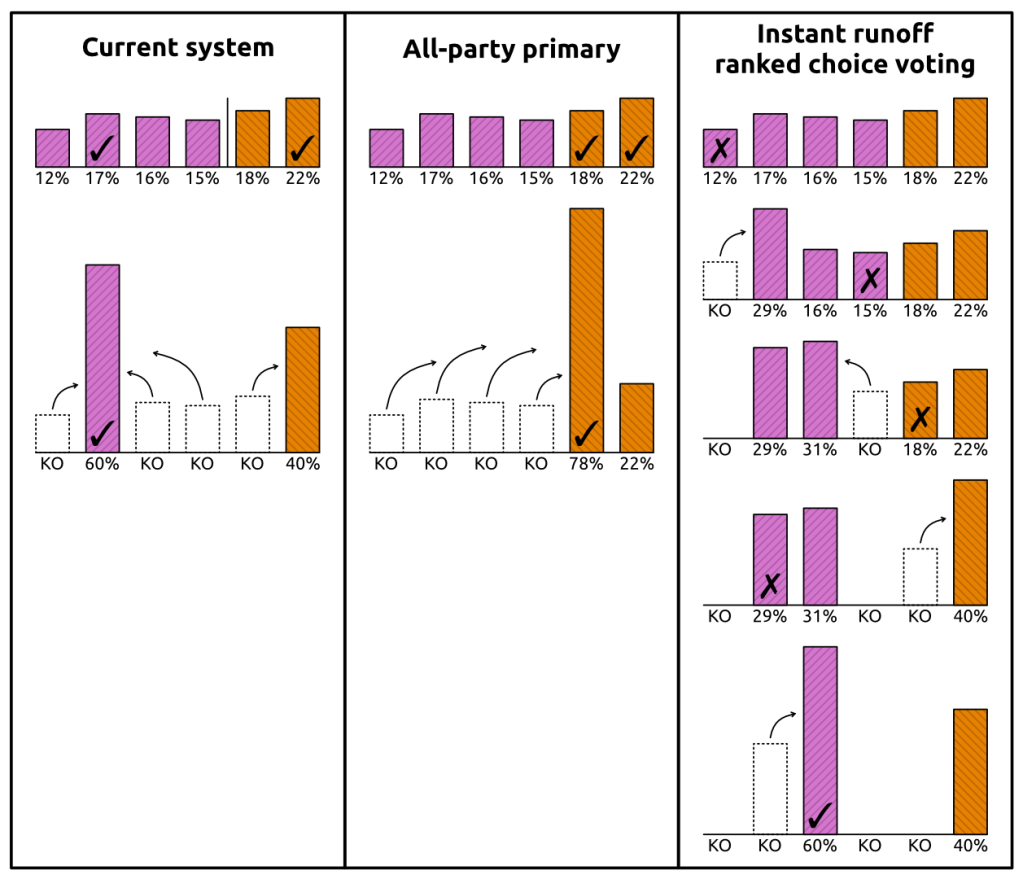
In the current system, one candidate is nominated from each party, and then they face off in the general election where the Pinkie easily wins. In the all-party primary system, because the large number of Pinkie candidates splits the vote, only two Oranges proceed to the general election. The more moderate Orange then wins.
In the case of instant runoff voting, if there is a primary and if only nominated candidates proceed to the general election, then it works the same as the current system. However, in practice we could expect to see more candidates without nominations run as independents, since doing so no longer splits the vote. The diagram assumes that all four Pinkies and two Oranges run in the same general election. The candidates with the fewest votes are eliminated one at a time, and their votes are transferred to whomever those voters marked as their second choice. Because most voter preferences follow party lines, this naturally results in a final showdown between one Pinke and one Orange, which the Pinkie wins easily (but not the same Pinkie that would have been elected in the traditional primary).
This shows how partisan primaries and ranked choice voting avoid vote splitting by design – in a two-party system, voters for each party consolidate behind a single candidate in the final round. All-party primaries lack this feature and are thus susceptible to illogical election outcomes.
Many of the people who support all-party primaries, like CHD founder Danielle Allen, also support ranked choice voting and argue that we should eventually have both. Unfortunately, the Massachusetts attorney general ruled in 2023 that the two reforms could not be combined into a single ballot question, but rather must be implemented separately. In my opinion, this means that ranked choice voting must be implemented first. Ranked choice voting without all-party primaries is, as shown in the example above, a perfectly reasonable election system, and an improvement over our current system. But all-party primaries without ranked choice voting are, as established in the previous sections, deeply flawed.
* I should note that there are other ranked choice voting algorithms besides instant runoff voting, some of which I think are even better. My favorite is minimax voting, where you simulate a round-robin tournament of one-on-one elections and choose the candidate who can beat every opponent, or who fails to do so by the smallest margin.
Question 3 is almost entirely funded by wealthy investors
I actually find it surprising that an all-party primary question is being run instead of a ranked choice voting question. After all, instant runoff ranked choice voting was run on the ballot in 2020, and Danielle Allen was a co-chair of that question’s campaign. While it unfortunately failed 45%–55%, thus barring it from the ballot for four years, it’s now been six years, meaning that it could have been run again this year. It’s natural that advocates would hesitate to run it again so soon, but given that it only failed by a small margin back then, I wager it would have a decent shot if run again today. Also, unlike the question that was run, it would have actually been good.
Many critics have argued that there may be an ulterior motive to explain why this question was run, and point to the CHD’s funders as evidence. While the 2020 ranked choice voting question was funded by a variety of entities including advocacy groups, Harvard professors, philanthropists, and wealthy investors, the 2026 all-party primary question is almost exclusively funded by wealthy investors. By my count, over 80% of the donations to the CHD (which also backs Question 1, the public records initiative) came from executives and partners of private equity and venture capital firms.
Critics have hypothesized that these investors are investing in Question 3 because they believe it will increase the role of money in politics. The theory is that with more candidates on the ballot and party leadership less important, funding will become more important. I don’t believe that, mostly because I haven’t seen evidence that all-party primaries actually affect campaign financing that much. I do think they have an ulterior motive, but I think it’s more likely that they hope it will elect more business-friendly Democrats, which will benefit them with lower taxes.
Danielle Allen insists that the donors are earnestly trying to help our democracy and that she intentionally networked among wealthy investors to fund this question because they had the most money to give.19 I don’t believe this either, because it’s inconsistent with how this group has donated to ballot questions in the past. After all, if they’re giving solely to support democracy, I would have expected to see similar donations from them to other good ballot questions from previous years.
Some of Question 3’s donors did donate to the ranked choice voting question in 2020, but not nearly as much. Randy Peeler, who gave over 1 M$ to the CHD this year, gave only 50 k$ to ranked choice voting in 2020. Most of the others gave nothing. We can also get insight into their political agenda by looking at how they’ve donated to other ballot questions. In particular, many of Question 3’s donors also donated to oppose the millionaire tax in 2022. The table below breaks down the contributions from a few of the CHD’s top donors.20
| Name | Donated to ranked choice voting in 2020 | Donated against millionaire tax in 2022 | Donated to CHD in 2026 |
| Randy Peeler | 50 000 | 0 | 1 050 000 |
| Andrew Balson | 200 000 | 25 000 | 790 000 |
| Mark Nunnelly | 0 | 0 | 500 000 |
| John Connaughton | 0 | 100 000 | 250 000 |
| Brian Conway | 0 | 0 | 200 000 |
| Paul and Sandra Edgerley | 50 000 | 2 000 000 | 100 000 |
So while some of these donors are probably donating out of the goodness of their hearts, the fact that most did not donate to the similar voting reform question in 2020 and that several donated against the millionaire tax question in 2022 suggests to me that at least some of them are more concerned with consolidating their own wealth.
Vote no on Question 3
The current election system in Massachusetts is by no means perfect, or even good. Turnout is low, and many incumbents run unopposed. Despite one party consistently holding a supermajority, the legislature is one of the least transparent and least effective in the country, and attempts to audit it have been unsuccessful for years. So it’s understandable that election reform is appealing to many.
However, this proposal would not help. In fact, it would probably make things slightly worse. Evidence shows that the benefits of all-party primaries, if they exist, are small. Meanwhile, experience in California and Washington shows that all-party primaries can cause the wrong candidate to be elected; to avoid this, parties are incentivized to influence candidacies behind closed doors. I believe the only reason this question has fundraised as much as it has is that it might elect candidates who support lower taxes on wealthy investors.
The real solution to our governmental problems in Massachusetts is probably some combination of broader civic engagement, stronger transparency laws, independent redistricting, proportional representation, and ranked choice voting. Don’t let the private equity and venture capital firms sell us this false solution – vote no on 3.
References
- Raquel Centeno, Christian Grose, Nancy Hernandez, & Kayla Wolf; “The demobilizing effect of primary electoral institutions on voters of color“; presented at the Midwest Political Science Association conference (2021). ↩︎
- Nathan Micatka, Caroline Tolbert, & Robert Boatright; “All candidate primaries, open primaries, and voter turnout“; Journal of Political Institutions and Political Economy 5 (2024). ↩︎
- Todd Donovan, Nathan Micatka, & Caroline Tolbert; “Can nonpartisan primaries boost turnout and lessen demographic disparities?“; PLoS One 20 (2025). ↩︎
- Joshua Ferrer & Michael Thorning; “2022 primary turnout: Trends and lessons for boosting participation“; Bipartisan Policy Center report (2023). ↩︎
- Steven Sparks; “Campaign spending and the top-two primary: How challengers earn more votes per dollar in one-party contests“; Electoral Studies 54 (2018). ↩︎
- “Does Question 3 increase the power of money in politics? What 13 000 races show“; Coalition for Healthy Democracy report (2026). ↩︎
- Christian Grose; “Reducing legislative polarization: Top-two and open primaries are associated with more moderate legislators“; Journal of Political Institutions and Political Economy 1 (2020). ↩︎
- Kevin Henrickson & Erica Johnson; “Does the top two primary system moderate the voting behavior of elected officials?“; Social Science Quarterly 105 (2024). ↩︎
- Thad Kousser, Justin Phillips, & Boris Shor; “Reform and representation: A new method applied to recent electoral changes“; Political Science Research and Methods 6 (2016). ↩︎
- Eric McGhee & Boris Shor; “Has the Top Two Primary Elected More Moderates?“; Perspectives on Politics 15 (2017). ↩︎
- Joshua Ferrer, Michael Thorning, & JD Rackey; “The effect of open primaries on turnout and representation“; Bipartisan Policy Center report (2024). ↩︎
- Eric McGhee; “California’s top two primary and the business agenda“; California Journal of Politics and Policy 7 (2015). ↩︎
- Lee Drutman; “What we know about Congressional primaries and Congressional primary reform“; New America report (2021). ↩︎
- Richard Barton; “How primary elections & reform shape governance and citizens’ lives“; Unite America Institute report (2026). ↩︎
- “Why Beacon Hill doesn’t look like Massachusetts“; Coalition for Healthy Democracy report (2026). ↩︎
- “State-by-state information“; Center for American Women and Politics. ↩︎
- Richard Barton; “California’s top-two primary: The effects on electoral politics and governance”; Unite America Institute report (2023). ↩︎
- Adam Nagourney; “California set to send many new faces to Washington“; New York Times (2012). ↩︎
- Danielle Allen; “Real choices and a legislature that listens: The case for Massachusetts Question 3, who’s paying for it, and why“; The Renovator (2026). ↩︎
- Massachusetts Office of Campaign and Political Finance. ↩︎

